


Hi, I Follow On Fb Even Though I’m In Cecil County. My Son’s Dog …
Hi, I follow on fb even though I’m in Cecil county. My son’s dog has been having anal gland infection for about 6 or 7 weeks she’s been treated with a number of different antibiotics they feel a mass up there they’ve done two different kinds of cultures and don’t see any cancer. I told them no more medicine we want to to go to a specialist and they sent us to Blue Pearl they looked at her records and noticed that she has MRSA they came back and one of those cultures and none of the medicines that she had been treated with covers MRSA. So they cultured it again today and we hope to have her on a stronger medicine that will cover that within a week. They at first had recommended that we go forth with the bilateral anal resection which we were going to do until they found that in her record and then we decided to try the medicine first between the other vet prescribing the medicines that did not cover MRSA even though a test that they had done showed it and all the different rechecks and more medicines my son is almost $3,000 in after today the surgery was going to be another 8000. We’re hopeful that the proper medicine for MRSA will work but if it doesn’t and we have to go forth with surgery can we get it at a better price than 8000. That with the almost three just astronomical. Any other advice you can offer would also be welcome. Thank you for all you do .
1 Response
Comments
What Does It Mean When Your Dog Is Not Really Eating But Drinking Water , He Pee …
What does it mean when your dog is not really eating but drinking water , he pee and boo boo he walks a lil wobbly he wines a lil bit sometimes he falls over
2 Responses
Comments
-

Krista Magnifico Hello,
Im sorry but it sounds like your dog is not feeling well. There isn’t enough information here to help e give you any guidance.
Your pup needs to be seen by a veterinarian and then probably needs some diagnostics like a bloodwork or Xray.
Medicine relies on many things like a history, examination and diagnostics to help understand what is going on inside your pet. The sooner your pup is seen the better your chance at getting better. -
Taylor Post author Yess we are at the animal hospital now !! Thank youu ☺️

Good Day! I Have A Great Dane With A Lipoma Between Her Muscles On Her Left …
Good day! I have a Great Dane with a lipoma between her muscles on her left rear leg. Our veterinarian did a biopsy which confirmed the Lipoma. Our Vet was unable to remove it. We found a veterinarian surgeon but the cost was prohibitive. We saw your YOUtube video about this problem.
Would you be able to help us? I am willing to travel. I would also accept a referral.
We live in Sarasota, Florida.
Jenny
1 Response
Comments
-
Krista Magnifico Hello,
Im sorry to hear about your pup.
I know that the cost of care had gotten really prohibitive for people. I get it. But (big hit here) i am really far away from you and i am not a surgeon. In cases where the mass id large, or in a concerning place these patients are best served by a boarded surgeon.Around me there are quite a few surgeons. The surgeon who comes to my practice is awesome. She is also about 1/3 of the cost of a surgery at a referral facility.
Have you asked your vet if they can help find you someone more affordable? Are they a corporately owned facility referring you to another one of their corporately owned specialty centers?
Put out a plea on social media for recommendations and see if you can find a private independent surgeon who might be more affordable. If this doesn’t help go to
The Pet Good Samaritan Fund and see their list of local providers. See if anyone there can help.
If all else fails email me back and we can try to find you help.Good luck.
My 16 (maybe 17) Year Old Tortie Cat Rose Is Constipated Maybe Has Megacolon? This Happened To Her …
My 16 (maybe 17) year old tortie cat Rose is constipated maybe has megacolon? This happened to her about a year ago. Had to take her to emergency where she had an enema. We changed some things around and were doing well.
The past Friday started out normal, when I got home from work she was hiding and had vomited, mostly food, around the house. She then postured like she was going to defecate and nothing happened. From my experience with her last time i figured she had a piece of poo stuck. Started her on lactulose and was going to call the vet in the morning. Being a holiday weekend her vet, and other vets were not open. I was forced to go to emergency. Because this was familiar to me, I opted not to do an x-ray (due to cost) and had an enema done with subcutaneous fluids and anti nausea with continuing lactulose and adding MiraLAX. She didn’t poop that night and the next morning she hadn’t peed either. She was also acting a little funny. Back to the ER we went. This time we did x-rays and bloodwork. She was full of poop. Vet said option 1 would be keeping her hospitalized with an enema every 6 hours with tube down her throat with a flow of miraLAX then re xray. Cost was well over $4,000, not to mention the stress. Option 2 we could do another enema but she didn’t think that she would pass the stool and basically suggested that I consider putting her down. Due to her age and the chronic nature of megacolon. After lots of tears and thought I asked if we could try the enema again more fluid, drain her bladder and keep up with the laxative routine. I wanted to give her a chance. So we proceeded. Vet was able to pull a lot of poop out and on the way home she passed two more pieces of stool, then later that night pooped again. She’s still a little off, but she went thru a lot the last couple days. I have a follow up appointment with my vet.
With what I have read about megacolon, I realize that at some point the mobility will be lost and surgery is the only option, with her age I don’t think that would be in her best interest
.
But I also refuse to accept that I should be seeking euthanasia at this point. Is that wrong? Am I putting her thru way too much?
I would like to adjust her diet to a low residue and add cisapride to her regiment.
I know that was a long story to get to such a short question, but I am sure I am not alone in this. I just want to give her a fighting chance within reason. I uploaded her x ray, I’m not the most computer savvy so sorry for the roughness
Thank you to whomever takes the time to read this.
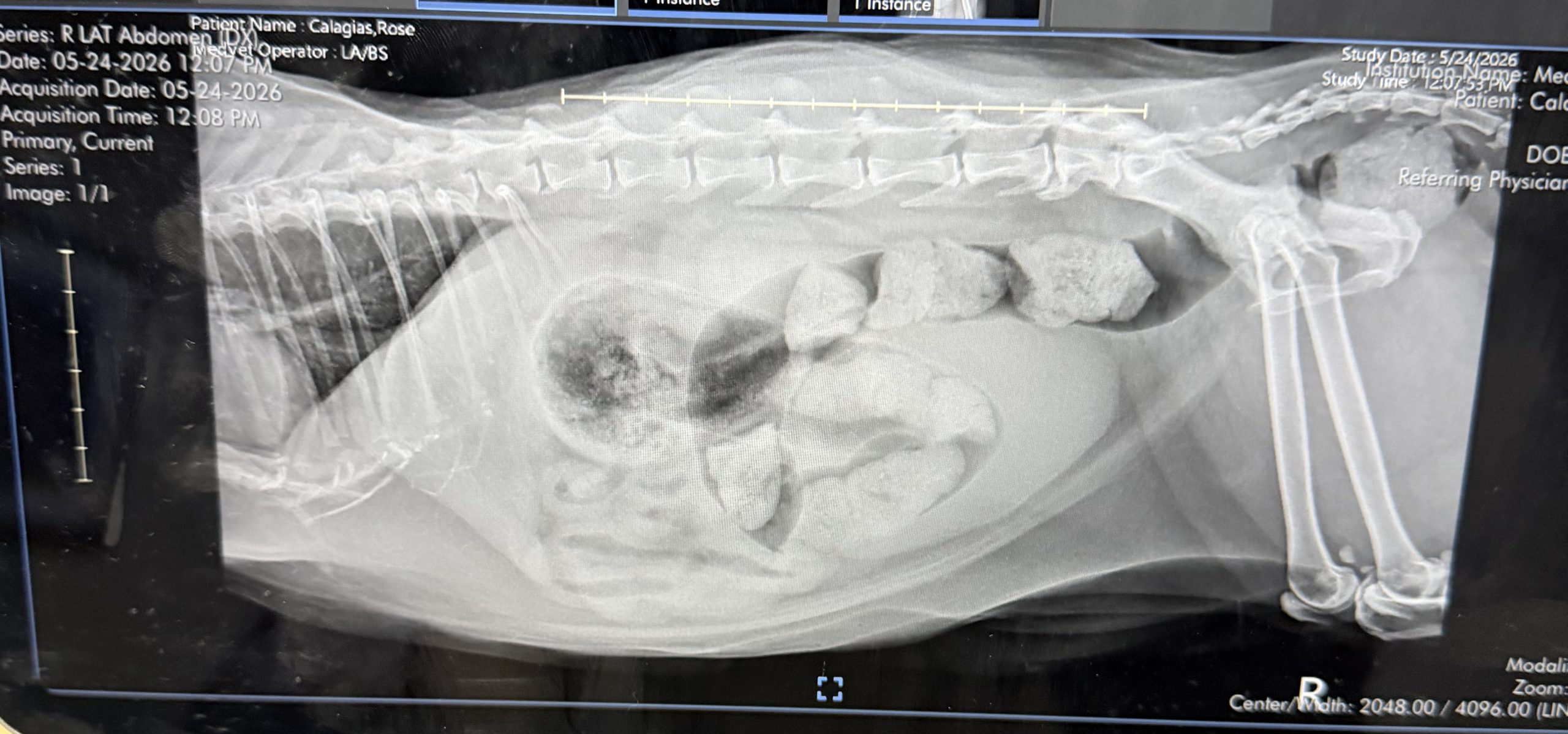
2 Responses
Comments
-
Krista Magnifico Hello,
I do have some information about this subject on my youtube channel and blog. In general I recommend you find a good general practitioner to help you. I also recommend lots of exercise and play. Trying to get the gi tract moving is about keeping active and moving. Also keeping them on a high quality food. I prefer canned food. I even add water and miralax. I also show my clients how to palpate their cats abdomen and give sq fluids at home. These are all things to talk to your vet about. I do also recommend a blood work panel to look for concurrent disease like kidney or thyroid. .
-
Demitra Post author Hi,
Thank you so much for getting back to me. I did get her blood work done and other than a small elevation in her Globulin 5.4 the rest looked okay. I will definitely talk to my vet about the above and check out your blog. I found you when I watched your video on how to palpate a cats abdomen. I tried it this afternoon. I’m going to watch again it again and try again.
Thank you
Outdoor Brands, Food Labels, And Lifestyle Labels Alike Love Custom Trucker Caps – A Perfect Mix Of …
Outdoor brands, food labels, and lifestyle labels alike love custom trucker caps – a perfect mix of retro and wearability. The structured foam front offers a striking embroidery surface for logos and artwork, and the breathable mesh back will allow for all-day comfort. From grime to glam, with a variety of colour options and snapback closures, trucker cap UAE is a no-frills, fashion-forward headwear option for any company, big or small.
0 Responses
I Had Seen, Dr M That Your Clinic Has Seen A Rise In FIP, How Much % …
I had seen, Dr M that your clinic has seen a rise in FIP, How much % you think in increases have you seen? Also have seen the info on Fcov-2 scary.
0 Responses
Dr. Magnifico-URGENT- I Have A 14 Year Old CKD/CHF/Anemic Cat That Is Having Some Heavy …
Dr. Magnifico- I have a 14 year old CKD/CHF/Anemic cat that is having some heavy breathing and very weak! She is on Varenzin however, I believe she needs an Iron Dextran shot. She was on Aranesp previously (had to remove her due to her having seizures from the medication) however, it was tanking her iron, so she had an iron dextran shot and it helped a lot. I’m having troubles finding someone that can do this fast. Is this something you offer and how quickly could she receive it? I believe she is tanking but VEG just quoted me $4-6k to bring her in!!!! I’m already at $30k and just don’t know I can do that right now. Also, if she is at the point of needing a blood transfusion, where can I get that done and NOT spend $4-6k???
1 Response
Comments
-
Krista Magnifico Hello,
The assumption is that the labored breathing is due to the current and concurrent medical conditions. If that is the case then what are you hoping to gain by spending more money on a disease that sounds like it is in the end stange?
Where are you ready to say goodbye?Has anyone spoken to you about the place she is at and the possibility of this all being futile care?
I’m not trying to send like I am not empathetic but there is no amount of money that will change this nor change the fact that you will likely have to say goodbye with a very painful decision soon.
Please ask a vet to be honest with you and not make this about the money that you cannot afford.
I’m sorry. It sounds like your cat is suffering and this is not curable. It’s ok to let her go. She was loved. You did everything you could. Try to be at peace with that.
I Am In Very Bad Place I Have Cats Developing FIP At A Fast Rate Within 2 …
I am in very bad place I have cats developing FIP at a fast rate within 2 weeks of ex poser all older cats 10 plus I be leave it is the FCOV-2 variant. I Have lots in door cats. One of my healthy out door only cats got sick throwing up acting neurological. I took him vet next day blood work was off A:B ratio was in the gray zone kidneys enlarged Cat has not gotten any better ordered EIDD-2801 will be here tomorrow I have 10 cats showing signs. FIP is never in my mind set from out door cats this spread like wild fire. I am asking for help for contact at some at university or some where who is researching this. I am trying not lose them plus I want to make sure this not a missed opportunity for information to be gathered. I am very scared and depressed.
2 Responses
Comments
-
Krista Magnifico Hello.
Im so sorry to hear about your cats.Fip is such a devastating disease. There is now finally hope with the advent of the Bova GS – 441524 treatment. I think that Stokes Pharmacy has a very good write up on this if you want to see their website. I also know that multiple other manufacturers now make this so you can shop around for a price that might work for you. I ordered from chewy last week to get this medication overnighted to us for a cat.
Good luck!
-
Evan Post author Thanks Dr M. This is the second time dealing with this. I went with eidd 1932 the data what I have seen says it dose better at older dry fip cases. Also cost full 84 weeks is 299. But this has moved fast faster then normal fcov. I have been taken care of 30 plus cats for years . I am on the spectrum I watch patterns. This how manage their health. You feel alone with all these animals in the world of corp greed and dvms bandwith are running thin. I have videos I haven’t put out before I knew about you. Stating where we are at. Nobody wins expect bane ,mars, blackrock. I mean they own the food insurance the clinics and the drugs. Dvms putting animals down when they know they can save them is hard on the soul, It why I believe you suicide rates are at the top now, owners feel the same if I only had that 1500 bucks now I have to say bye to part of my soul. Like I said nobody wins except stock holders. I am got in my situation not by 100% choice. When this all started for me a can of science diet was 89© Now 299ish not vet diet. Now own by colligate ugggggg. I have some clinics that are fair but I have to travel to get to them. All our clinics in our town price set have a lunch in at set prices. Locally in town full panel is now 245. My country vets are 130. I know what things cost cost vet 89 . They need to make money but 130% . Animals suffer with these prices. I am sorry for the rambling I have a lot anger and passion about this subjects. Thanks Dr M
My 17 Year Old Cat Has Always Had A Runny Nose And Weepy Eyes. Lately It Seems …
My 17 year old cat has always had a runny nose and weepy eyes. Lately it seems the sneezing is a little worse. A friend told me her cat had always been the same way and her vet told her to give her cat 1/2 of a zyrtec pill because it’s allergies. My baby is taking methinazole 5mg, 1/2 tablet twice a day for thyroid issues. Would it be safe for me to give her the 1/2 tablet of zyrtec to help with her sneezing and weepy eyes?
1 Response
Comments
-
Krista Magnifico Hello,
Im sorry but I cannot provide an answer for this. Medication advice should only be provided by a veterinarian who knows your pet and their unique medical status.
Can You Find A Nasal Polyp Without Doing A CT? My Cat Has Chronic URI Symptoms …
Can you find a nasal polyp without doing a CT and using a Xray? My cat has chronic URI symptoms that are not resolving with 3 rounds of different antibiotics. She is sneezing blood droplets and has strider sounds in chest, lungs are clear.
1 Response
Comments
-
Krista Magnifico Hello,
A polyp in the nose is both hard to identify and hard to remove. I don’t think that there is any other way than a ct scan and a scope. I also think that they are less likely than a tumor or a polyp in the mouth or ear.Wish I could offer better advice.

Hello,
It sounds like someone didn’t read the culture correctly? Did you address that?
If you need an anal sac removal we have a boarded surgeon who does this at the clinic. She comes to us twice a month. The cost is somewhere at about half of the $8,000 estimate you listed above.
To discuss this you would need to make an appointment at the clinic with me for a consultation and exam.
Sincerely
Dr Magnifico