

Question
Profile Image
Jennifer Taylor | 6 years ago
A Year And A Half Ago We Rescued A 4 Week Old Kitten Who Presented Unresponsive With …

A year and a half ago we rescued a 4 week old kitten who presented unresponsive with a body temp so low it did not register. She was revived. As the caretaker was going to put her back out that evening I stepped in and offered to take her with the plan to rehome her. I have rehomed dozens of kittens over the years, all who came from feral colonies. From the get go Annabelle was incredibly sick and had behaviors that weren’t what we were used to. When held she would attack faces, when stimulated she would attack, we continued to work with her and a year and a half later she lays with us at night and as long as we don’t touch her does not attack people. Instead she attacks items. This occurs whenever there is any stimulation in our home, folding laundry, cleaning out a closet, dogs playing, children laughing, the list goes on and on. She has destroyed a sofa, armchair, curtains, tablecloths, comforters, sheets, duvet covers, etc, etc. We can not trim her nails….because we can’t handle her and truly even with her nails trimmed I am sure she would rip things apart with her teeth. We are no stranger to ferals, I am happy to allow them to hide until they feel comfortable, there is no hiding with Annabelle instead she literally runs into the chaos. When we let our dogs out and at feeding time out she runs into the chaos, when I vacuum she runs around the room, when we have company she runs around as I warn our guests not to touch her. We are no stranger to keeping cats happy, we have cat towers, scratching posts, scratching boards, elevated areas, areas to hide. Our other 4 cats are incredibly happy members of our family. I am at my whits end, I honestly feel like we attempted to tame a raccoon and are living with it in our house. I do wonder if Annabelle would be happier outside, but with no sense of danger and a habit of running into the chaos I can’t help but worry she would get killed….and I didn’t save her to have that happen.
I am open to suggestions and curious if anyone has ever had a similar experience.

6 Responses

Comments

  1. Sarah

    Hi Jenn- I don’t know if this advice will help, but Dori is crazy like that too. While she has free roam of the house, we have things set up where she also has areas that are just hers, and that seems to have helped a little bit. She still “kills” furniture and pillows, but it isn’t as bad as it was.

    1. Jennifer Taylor Post author

      Thank you, I am comforted in knowing we aren’t the only ones with a different cat. We are finishing our basement. The cats will have the laundry room completely to themselves with a kitty door. We are also making our screen porch a cat haven. I am hoping that helps.

  2. Laura

    Some cats truly are happier outside – usually far fewer than people think, but she sounds like one of them. Do you happen to have a catio or a large dog crate you can put her in outside, just to see how she does?

    Would you consider rehoming her to a farm?

    The fact that she doesn’t seem capable of integrating is frustrating, and I can only imagine how you feel.

    1. Jennifer Taylor Post author

      We do have a large screened porch, she does enjoy spending time out there. We are in the process of making a cat “jungle gym”, an area where the cats can climb and be up high while on the screened porch. We also actually do live on a little farm. If she wanted she could be an outdoor or indoor/outdoor cat. Her tiny stature and inability to assess danger make me nervous, we have fox and coyote….I guess I am afraid she would be killed. On the other hand I really don’t know if she is “happy” being kept as a house cat.

      1. Laura

        I completely understand that fear. I’m of the opinion that the vast majority of domesticated felines should be kept safely behind walls and screens, so I get your reluctance. I also know some cats really just cannot be housed indoors. Good luck.

  3. Krista Magnifico

    Hello,
    I think it comes down to a few key points to consider.
    One is she just a wild child at heart. And if so could we break her free form that with time, containment (to which I mean she would have to be caged for a long time. Think Diedra’s cat Tulio)… and then still be prepared to just having an angry hostile cat. I don’t think this is my favorite option because she isn’t afraid of people she just plain old doesn’t want to be around people.
    2. Try to medicate her into being happier. May take a few months and may cost you value finger sensation for the rest of your life.
    3. Let her be who she is and be happy. Maybe she is just the free wild spirit and maybe she won’t live as long as possible but maybe that’s how she wants it.

    I think it really comes down to a spring her as who she is. Allowing her to live her life in her terms and loving her inspire of not being able to advise her.

    I’m sure this is of no help. Sorry. I can help with the caging and meds if needed. Xox

Question
Profile Image
Holly | 6 years ago
Hey Everyone! I Was Hoping I Can Get Some Insight On How To Battle For Ringworm …

Hey everyone! I was hoping I can get some insight on how to battle for ringworm in my household? we adopted a cat from the humane society and they were not aware that he had ringworm and it has passed to the 2 humans in the house and the other cats.

I’ve been doing the daily cleaning, washing the sheets, vacuuming, spraying Lysol, wiping surfaces down, etc. I got topical medicine for both humans and cats.. I have lime sulphur on order. I also have deep played my couch covered with plastic and tarp and sheets. Cat towers are outside to be cleaned and stored away until it’s over.

Is there any of suggestions? If I would lock my cat’s in the basement and keep them away from the living quarters could that possibly help keep it contained and help eliminate the issue?

Thanks in advance! I appreciate any opinions!/advice I may get! ????

5 Responses

Comments

  1. Sarah

    Good morning- ringworm is usually medicated with an anti fungal treatment from a prescription. I am not sure if anything over the counter is safe for your cats- you should call your vet about that. Meantime, quarantining your cats will help. Be sure to wash your hands after you handle them. It sounds like you are definitely on top of things as far as laundering and cleaning. I would recommend li trolling your furniture and then throwing the tape out- just to help get all the fur the vacuum may miss in case there are spores on it. Best of luck!!!!

  2. Krista Magnifico

    Hello,
    Have you spoken to your vet about this? There are OTC medications that can be tried and oral medications, and like the lyme sulfur topical shampoos. In some cases I shave the cats down (if they are long haired) and make sure they are otherwise healthy. I have seen it happen many times in newly rescued cats. It will run its course and it is a big nuisance I know but it passes. Please call your vet and ask for help.. There is a lot you can do.
    although I am not a VCA hosptial fan this is a good article
    https://vcahospitals.com/know-your-pet/ringworm-in-cats
    now Maddies Fund I love;; this is helpful too
    https://www.maddiesfund.org/kb-ringworm-in-cats.htm

    I guess i would just say to please stay calm, be patient and practice safe handling.. your kitties will be well soon..

    be safe and best of luck!

    If it is any consolation I once had 10 of my clinic cats all get it.. We had to move them to our adjacent house for two months,, but they all got better!

    1. Holly Post author

      Thanks so much for the info! I appreciate it! I have talked to a vet who suggested lime dip and OTC cream. She said I can to oral, but since I caught it at the beginning I may not need it. So I ordered so lime dip, pet collars and going that route. The ringworm spots have almost disappeared with just the topical cream and only 1 more spot has popped up. However, I am still going to treat them all with the lime dip and keep up with the excessive cleaning for a couple more weeks.

      Thanks again, I really do appreciate the info!! 🙂

Question
Profile Image
michelle | 6 years ago
I’m Taking Care Of A Siamese Who’s Over 10, An Indoor/outdoor Cat. I Did …

I’m taking care of a Siamese who’s over 10, an indoor/outdoor cat. I did a cbc & chem bloodwork. His BUN is only slightly elevated. His issue is throwing up daily, weight loss, & diarrhea. His vomit is undigested food & liquid. He eats very little wet food & his owner just feeds all of them the worst dry food. I give him sq fluids as needed & started cerenia. Yet this is not treating the underlying cause. Does anyone have any advice on this? I have vet bills for my cows & my cats. Yet i still want to help all the animals I can. I obviously have very little money to help though. Thanks

1 Response

Comments

  1. Krista Magnifico

    Hello,
    Thank you for helping. I honestly feel like the best course of action right now is to get a diagnosis. Even a presumptive one. For this I think you should do the following. Find a cat vet or a very reputable vet that you trust for an exam. And then I would talk about checking the thyroid a fecal and probably also a urinalysis. For most of the cases lien this I just feel that I need a full set of basic diagnostics before I can begin to offer treatment plans. Otherwise I am eating precious time guessing and very likely guessing wrong. Things like intestinal parasites and hyperthyroid disease can be affordably treated. But cannot, and definitely should not be treated without confirmation. After that I talk about xrays and an ultrasound. I’m sorry. I can’t tell you what to do without knowing what it might be. And that list is very long. Start with the basics. An exam and a fecal. Talk about thyroid and go from there. Good luck. Let us know. Thank you for helping.

Question
Profile Image
Amanda | 6 years ago
My Two Cats Got Into A Tussle, And One Of Them Has A Scratch Right Down …

My two cats got into a tussle, and one of them has a scratch right down the center of his nose. He doesn’t seem to be bothered, but I don’t want it to get infected. What should I do?

1 Response

Comments

  1. Krista Magnifico

    Hello,
    In almost all cases I assume that a fight causes an infection. Please watch the area very closely. Any sign of swelling, pain or purulent discharge (like puss) are all signs of infection. If you see any of these, or inappetence or changes in s attitude or Behavior please call your vet. Hope this helps. Be well and stay safe.

Question
Profile Image
Leslie | 6 years ago
Our 9 Y.o. English Bulldog, Max, Is Experiencing A Very Itchy Face Only On The Right …

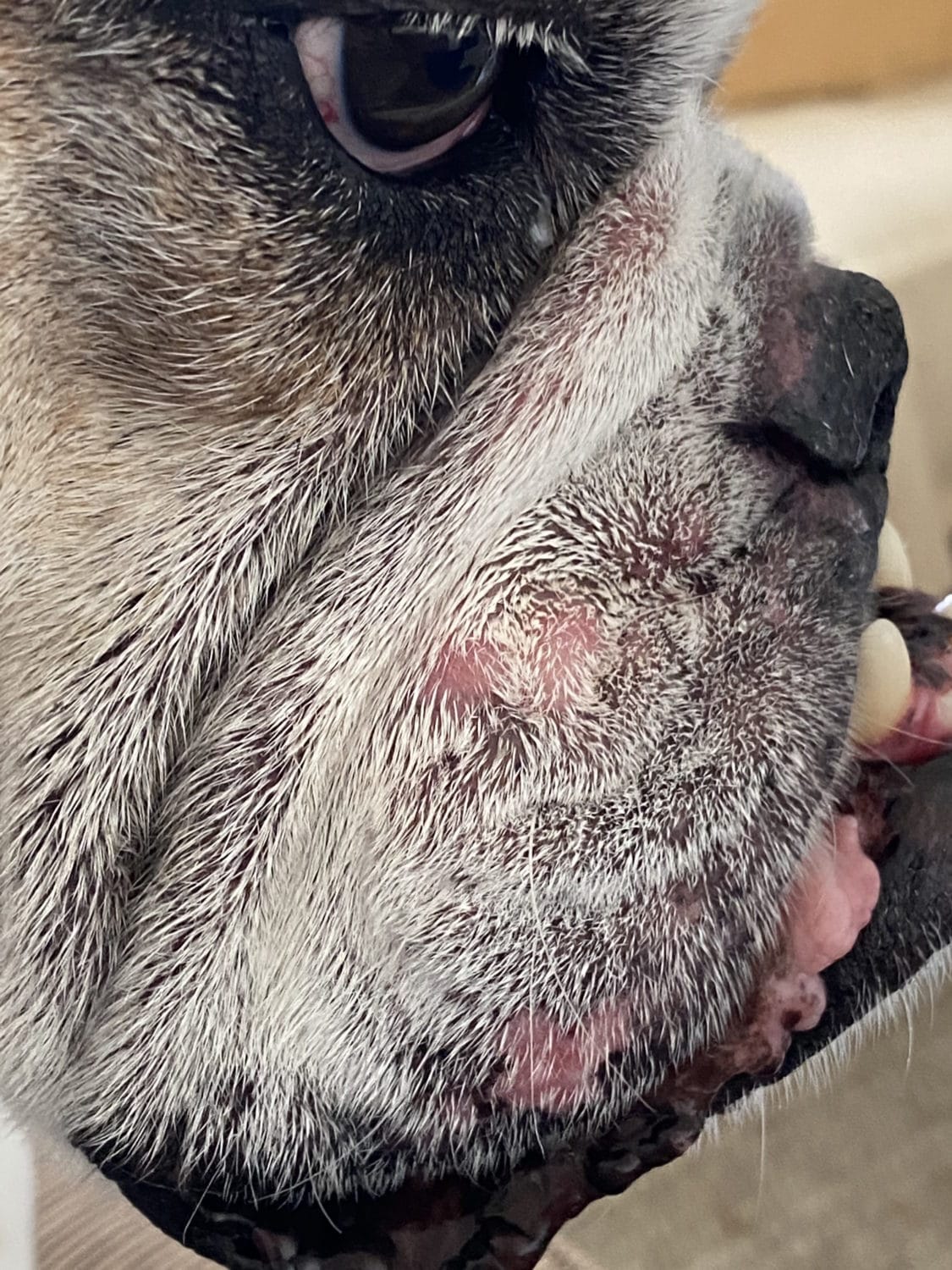
Our 9 y.o. English Bulldog, Max, is experiencing a very itchy face only on the right side. He will scratch daily and it sometimes becomes raw. We have moved to Colorado, but have not established a veterinarian here yet. With COVID-19, I do not want to take him out to the vet unless it is the only way to treat this. Is there something I can get online? I have seen great reviews for Coat Defense which, according to reviews, is used successfully for itchy skin on horses, dogs, and cats. Do you have any experience with that product or is there something else that could address both the itchiness and the root of the problem that you might suggest?

2 Responses

Comments

  1. Krista Magnifico

    Hello!
    So. Here is the problem. Your pups itch is probably too severe and deep to allow an otc to work well. Also and this is a big one, it is on the face. So you have to be crazy careful about what you use.
    I actually have used this product and it works well. But it cannot be near the eyes or mouth.

    The source is the genetics. Aka the plague of being a bulldog. The answer lies at the vets office. Start there. His history and breed make it important to go earlier than waiting for it to become a deep and difficult infection to treat and resolve.

    Be safe! Hugs to you all!
    Krista

Question
Profile Image
Yvonne Phipps Yeager | 6 years ago
For 20 Something Years, My Male & Female (a Year Older) Older Cats Who Were Neutered & …

For 20 something years, my male & female (a year older) older cats who were neutered & spayed for about 17 years. My female cat has now started to do number 2 on the floor over in the corner floor areas around the litter box. I don’t get it? Why now after All these years? How can I stop this? If I get another litter box, he will have to use it as well. And I can’t keep them in a room apart (that would be cruel) – they’ve had the run of the house for 26 years. I’d appreciate the help. Oh! The only real thing that has changed has been that our dog died (we took him outside to potty ). I’m wondering what’s going on & how to stop this? Thank you.

2 Responses

Comments

  1. Sarah

    When my pet’s behavior suddenly changes to some this big completely out of the norm, I try to find what has changed either in the environment (like the dog passing away- so sorry about ????that) or I try to find out what has changed with them. The latter takes an appointment to the vet. I would make an appointment and let your vet know everything that is going on and let the run some tests to make sure kitty is ok. Best of luck.

  2. Krista Magnifico

    Hello,
    I have found that in a huge number of cases there is some difficulty getting into the box and posturing to defecate due to painful old cat joints. So maybe try a very low sided box (or even a cookie sheet) to see if this helps. Also the box should be kept very clean and new litter places in it every week. In some cases I also offer a different kind of litter. Maybe even play sand (plain play box sand, or pitting soil) to see if this helps them Reacclimate to the box. Also make sure your vet checks for things like anal sac issues (had one last week in a cat) and urinary issues. I hope this helps. Please let us know what happens.

Question
Profile Image
Liz | 6 years ago
4 Days Ago My Cat Began Acting Really Lethargic. She Has Been Sleeping All Day And Won…

4 days ago my cat began acting really lethargic. She has been sleeping all day and won’t move. I offered her canned food on day 2 and she scarfed it down as well and drank water. Over the last 48 house she has declined severely. She is eey weak and has lost and extreme amount if weight despite my efforts. I have been syringe feeding her, stimulating her, administered Pedialyte as well as tried to maintain her hydration. I began subcutaneous fluids yesterday and she is still of a deep decline. I’m afraid I will lose her. She was fine the day before this started. None of my other cats are sick not have any symptoms at alll. She is 6 months old. Her name is Honey.

2 Responses

Comments

  1. Sarah

    Good morning. So sorry about your cat. Have you been in to see your vet?

  2. Laura

    What did your vet say when you took her in? You DID take her in the day this started, right? If not it’s beyond emergent now…

Question
Profile Image
Aimee | 6 years ago
We Brought A Re-homed Cat Home To Our House One Week Ago. She Is 4 Years Old, …

We brought a re-homed cat home to our house one week ago. She is 4 years old, spayed, up to date on shots and healthy. She came from a multi-cat and dog house to our single-dog house. Her previous owner says she had no problem standing up for herself against other cats and the dog (reports the other cats are much more willing to come out of hiding since she has been removed). We have noticed that she is shy and skittish, but eating and drinking. She spends most of her day hiding under a bed.

Unfortunately she refuses to use her litter box (so far preferring kids closets and under desks). We’ve taken a step back and confined her to a single room. She has a clean litter box. Food, toys and bed are at the opposite side of the room. We’ve also confined the dog to a separate part of the house

None of this is ideal. We have few doors, so keeping them apart also keeps the humans apart. I can put food or litter in another part of the house, but the cat is more likely to encounter the dog if I do that.

Thoughts?

1 Response

Comments

  1. Krista Magnifico

    Hello,
    In general I take the ridiculously slow and gradual approach to new cats joining the family. I do the following. I place a big cage with a little box in it and place that in a room by itself. The new cat is kept there with a big blanket covering as much of the big cage as needed until everything is calm and happy. This means the new cat is coming to you and purring. Using the litter box and eating normally. It can take weeks. We let them get used to their own new place before expecting them to adapt to ours. After they are doing well we open rhe big cache and let them acclimate to their own room. Now they can sniff the other animals under the door until that is also calm and peaceful. No hissing at others under the door. If that goes well so short small supervised visits with others housemates. If any thing doesn’t go well go back to bases. Ideally the cage and box stay accessible until the new cat is using the community boxes. If all else fails go back to small and safe. Cats need time and patience and they don’t always adapt well. Also super important to talk to your vet and rule out any issues. Think about different litter and litter boxes. Let you cat decide which they like. Hope that this helps.

Question
Profile Image
Chrystal | 6 years ago
I Rescued A Kitten Several Weeks Ago. He Was Said To Be A Female And To …

I rescued a kitten several weeks ago. He was said to be a female and to be 4 /5 weeks old. Took him to vet next day and she turned out to be a boy around 3 weeks old. Was very sick and had fleas really bad. He is healthy now but very aggressive. I have an 8 year old cat who has never been with any other cats. The kitten attacks him to the point he cries and I can’t get him to stop attacking my adult cat. Please help

4 Responses

Comments

  1. Sarah

    Good morning- keeping the kitten confined may help. I am confused as to how a kitten so small can have the ability to be attacking a full grown cat though. As far as introducing them, I would keep visits monitored , and go slowly.

    1. Chrystal Post author

      We are already past the introduction and at first they were fine and all was well. The healthier the kitten gets the more aggressive he gets. My adult cat will not return the aggression. I honestly don’t understand it either

  2. Krista Magnifico

    Hello!
    Here’s what has worked for me in the past. We set very strict schedules and regiments to help define acceptable behavior and safe times and zones. I think that the other very Important item to talk about is cats don’t think like us. They usually like and need the opposite of what we think they want. So. For cases like this we define individual and community zones. All cats get their own space where no one can bother or harass them. If needed cages are used. At the clinic with all of the cats coming and going we cage them at night and it reinforces a safe me only zone. It also reduces intercat aggression. Things like toys, Feliway and games help. Cats with too much energy are given toys to keep busy and burn off excess steam. Things like hunting for food (my way of scattering dry kibble instead of getting it given to you without working for it. I also use catnip, catnip toys, laser pointers and neutering ASAP. In some cases we have used harness training to let cats go outside on chaperoned walks.
    It’s important to say that you cannot reprimand a cat. They are not trainable like dogs. Reprimand will only cause fear and heighten aggression. If all else fails sometimes finding a kitten to play with your kitten helps. They can correct each other and exhaust each other. I hope this helps.

    1. Chrystal Post author

      Thank you for the advice. They did well last night and Koba, my adult cat actually layed with me for an hour like he did before Stinky Pete, the kitten came. The vet said he can’t be neutered until May so that will have to wait. I say a lot that I will send Stinky Pete packing but I honestly would never do that. He is with us til I pass and at that point one of my kids will take them then.

Question
Profile Image
zeta rose id | 6 years ago
Hi There, I’ve Been Feeding Some Stray Cats Near My Work Place And Recently I …

Hi there, I’ve been feeding some stray cats near my work place and recently I noticed one of the male cats has crusty lesions on several places of its body like on the nose, the cheeks, the balls. I googled some pics online and his condition seems to match feline herpes virus. I tried to trap him for a vet visit but he just won’t let me. I asked some vets in my area but they insist on me to bring in the cat. So I think that option is pretty much impossible. Is there any kind of human antibiotics or supplements I can give to the cat? Something I can sneak inside his food? Thank you!

1 Response

Comments

  1. Krista Magnifico

    Hello,
    Have you reached out to any of the local rescues around you? There are really few medications that cats can get and fewer that are for humans. So it isn’t really safe to do that. Also I would think this cat will need more care like rabies vaccine? Spay/neuter. Etc. Also some dermatology conditions can be treated with a topical or injectable option which is far better and safer for these cats. Please call and ask for help. In our area there are multiple cat rescues who will help with trapping and caring for ferals. I hope there is someone near you.