





Question
Profile Image
Holly | 1 month ago
9 Year Old Female Spayed Cat – Bladder Stones

I have a 9 year old female spayed cat. I took her to our normal vet because she was not acting herself. She had recently had a checkup with no issues, however, I had noticed she was spraying in different placed in the house which again is not like her. We have 2 doxies in the house as well. They did x-rays and said she had bladder stones and a couple in her urethra and they called so we could go over to their other emergent location to see if they could possibly flush those out. So I then took her to the emergent location and they took her back and were able to get a catheter into her and push the stones back but said when they did that, they came right back into the urethra. They then suggested that I start her on the special diet right away and hopefully that would help in time to shrink the bladder stones and maybe she could pass them. They said I should bring her back in about 6-8 weeks which will be towards the end of this month to do repeat x-rays. If she still has the bladder stones, they suggested her getting a cystotomy and said it would be over $3000. They also told me to closely monitor her to make sure she doesn’t get blocked and if she does to take her to the ER right away which I know would be even more expensive. I was hoping you could offer some insight on how much your practice would charge for a cystotomy and should I just go ahead and get that done? I have been monitoring her but I am so afraid she will end up blocked and I don’t want that. I have seen many of your videos helping the cats that have been blocked and I am so thankful you have been able to help them. I hope you can help me navigate the best direction for my kitty.

1 Response

Comments

  1. Krista Magnifico

    Hello,
    I’m sorry to hear about your cat.
    We have some of the prices of some of the surgeries we do available in the storylines section here.
    A cystotomy is about $1500-2000. It really depends on how long the surgery is. In general cats are quicker and easier than dogs, but, little stones can be real buggers to remove.
    There are lower cost clinics available. They can be found on our Jarrettsville veterinary center website.
    There is a possibility they might dissolve, but, I had found this less reliable for cats than dogs and the real possibility that they slip into the urethra and obstruct the bladder from emptying is a potentially fatal consequence, therefore I had to advocate for surgical removal asap.
    Let us know what happens.
    Dr Magnifico

Surgery
Profile Image
Lucy | 2 months ago
14 Year Old Silky Terrier Needing A Dental With Extractions And Growth Removal
Treatment Cost (USD): $844.30
0 Responses
Surgery
Profile Image
Lucy | 2 months ago
14 Year Old Silky Terrier Needed A Dental And Mass Removal
Treatment Cost (USD): $621.94
0 Responses
Question
Profile Image
Diedra Cardamone | 2 months ago
Good Morning! First And Foremost, Thank You For Doing The Work That You Do! I Have …

Good morning!
First and foremost, thank you for doing the work that you do!
I have a 7-year-old orange tabby named Milo. He started having seizures a couple of years ago. It became frequent enough that the vet decided to put him on the antiseizure medicine Phenobarbital. That was working okay, but then I started to notice that he was losing weight. Now, just to be clear, Milo enjoys his food, so he could benefit from losing some weight. However, he lost a considerable amount of weight in a short period. He also became lethargic.
I took him back to the vet, and after bloodwork, it was determined that it was affecting his liver, and he was anemic. The vet wanted to put him on Zonisamide instead. It was expensive, but we didn’t mind. We were told that the options were limited as to what he could be put on, and this was the only other suggestion that she had, so we took it.
Fast-forward a couple of months. It became nearly impossible to give him this medication. Milo would hide all day, and when we dragged him out of hiding to give him this medication twice a day, he would foam at the mouth and run back to his hiding spot. He was traumatized (I think!) from taking this medication.
My husband and I sat down to talk about this. We decided that we were going to take him off the medication because we wanted a better quality of life for him. At this point, he is back to being healthy overall (except for the few extra pounds he still carries).
He still has seizures, and on average, I would say that he has two a month. They are always at night. I’ve read that nighttime is a trigger because of increased brain activity. When he has them, they typically last under a minute (I’ve been woken up by him when he has them because he sleeps with us). He loses control of his bladder and will pee. He will foam at the mouth. Once he “comes out” of his seizure, he will then circle and meow for five (ish) minutes after. He is typically back to normal within 30 minutes.
Here are my questions:
(1) Would you recommend that he go back on antiseizure medication?
(2) Are the seizures affecting his brain? Or are seizures typically harmless?
(3) If medication is recommended, are there any other options besides the two that we have already tried?
Thank you for any insight you can give! I just want what is best for our Milo Man, and if that is medication, then we are fine going back down that route. But, at the same time, I do not want him to live in fear of taking the medication.

1 Response

Comments

  1. Krista Magnifico

    Hello,

    Ok this is a tough one. It’s one of those that is so tough I defer to a neurologist.
    If you can’t get to one see if you can find a feline specialist. They might want to talk to you about gabapentin or Keppra.

    When it comes to seizures we have to feel like they are frequent enough to warrant life long medication. IMO your cat is having them often enough to consider treatment.

    Next, this is a cat. They make everything a little more challenging. They like life on their terms. Period. Hard stop. So, you have to be willing to compromise and make a plan B, ( and then C-Z).. 😉

    I empathize with your dilemma. I just can’t give you an easy answer.

    Best of luck.
    Please keep me posted
    Dr Magnifico
Question
Profile Image
Kate | 2 months ago
My 8 Yr English Bulldog Started Dragging His Front Foot A Few Weeks Ago.(what I Now …

My 8 yr English Bulldog started dragging his front foot a few weeks ago.(what I now know was knuckling) It started after we dremeled his nails and thought maybe we just did one too short. A few days later, he was running in the yard and face planted repeatedly. We took him in and the vet said she thought it was neurological. They did X-rays and showed us that he has no space between some of the discs. She said they could refer us to a neurologist and we could do an MRI and surgery but that would cost ballpark $15k which is not feasible for us. She also said that considering he is 8, he has lived a long life for a bulldog. We were given a steroid, muscle relaxer and something for pain. She said if he showed no improvement in a week, that we need to look at quality of life and consider euthanasia. I have since done my own research and believe it’s IVDD. It seems to be affecting his left side so he can’t balance himself. I immediately set up a large crate and he has been in it for a week now. He is eating and drinking. He is urinating and defecating. He has feeling in the limbs because he responds to me tickling his feet. I’ve also seen him use both limbs to push himself around in the crate. He seems to be his normal self except his ability to stand/walk. He’s getting annoyed now being in the crate and barking a lot to get out. At what point do I try to get him to stand & walk? I know this could take weeks/months of crate rest. I found a vet 1.5hrs from me that does acupuncture for IVDD and am considering that also. Appreciate any advice. Maybe naive, but I refuse to believe this is an automatic death sentence for an otherwise healthy but chunky happy dog.
Thanks so much.

0 Responses
Question
Profile Image
Breanna | 2 months ago
My Dog Has Allergies And Has Been On Apoquel For 2years Now. She Was Perfectly Healthy …

My dog has allergies and has been on apoquel for 2years now. She was perfectly healthy up until we got her spayed and now she is constantly itchy, losing fur, red and raw. Its not fair for her to keep living like this as she cant be happy or comfortable. The apoquel is no longer working for her.
We are looking into switching from kibble (she is currently on Purina One Salmon) and was previously on Purina One Chicken Digestive Support (for sensitive stomachs) to a cooked/raw diet. Are there any resources that have vet approved recipes/diet plans? She is a 50lb dog.

This is the base recipe we were going to go with….. does this seem okay? Would you add or change anything to it?

Twice a day…
1lb frozen Salmon (thawed)
Sweet potatoes
Blueberries
Keifer
Greek yogurt
Hemo seeds
Cooked egg in olive oil
Egg shells ground up and mixed into the food
Turmeric
Can of sardines in olive oil
Possibly some cooked rice depending

1 Response

Comments

  1. Krista Magnifico

    Hello,
    I’m sorry to hear about your pup.
    I have to preface my answer by saying that I am not a veterinary nutritionist and therefore I cannot assess your pets diet. You can find a boarded nutritionist at this site. https://balance.it/dacvim

    I want to add that I see a lot of dogs with allergies and a very (very) few have a food sensitivity allergy.

    There are lots of options for helping alleviate allergies. Your vet, or a veterinary dermatologist can help.

    Good luck.

Question
Profile Image
Rob | 2 months ago
My Seven Year Old, 27lb Beagle Olivia Had Her First Run In With IVDD In December …

My seven year old, 27lb beagle Olivia had her first run in with IVDD in December of 2024. It was very mild and was mostly pain with little mobility issues. An X-ray at that time showed some possible compression in the rear third of her back but nothing significant. She was treated very conservatively with Rimadyl and the pain resolved within two weeks without crate rest. She led a fairly normal life since then.

Last Monday evening here in Northeast Ohio, it was about -8 degrees outside. I let her out to urinate and she was walking normally. She crouched down, used the bathroom, and came back in dragging her legs behind her with an arched back. She had trouble urinating and defacating due to the pain in her legs and back. She could put some weight on them but would lose footing very quickly.

Her doctor has placed her on strict crate rest (which she hates! She has worn a sore into her snout from barking and running her nose across the top of the crate when I am not home). This is even on 200mg of Gabapentin 3x/day and Prednisone 2x/day. The doctor has advised he wants a full week of Prednisone in her before we refer to a neurologist. I pick her up to potty and only let her stand as long as necessary to relieve herself. Within two doses of Prednisone she was able to squat almost normally (with jelly legs) to relieve herself. Now that her pain is seemingly better, she has been moving quite a bit around her crate despite my efforts to restrict her.

I don’t know what I should do…Should I insist on a visit to a neurologist? It hurts me so very much to see her like this and I feel absolutely hopeless thinking that I’ll have to crate rest her for months on end. Your videos helped ease my mind a little bit, but the doubt and worry are consuming me about my poor girl. I have a second beagle, Rex (he is five), and now I’m afraid to let him use the stairs in my split level house, or act like a beagle in general!

I never thought my life could be so overturned by such a horrible canine disease. My dogs are my family. Anything that one could offer so far as assistance would be so very much appreciated.

1 Response

Comments

  1. Krista Magnifico

    Hello,
    The best advice is going to be found at the neurologist, They can provide the best options for you both, BUT, I do not send people to them unless they can afford both the exam fee, and are prepared for the recommended diagnostics and treatment options. You should never feel pressured to seek care and advice, but, it can be costly to treat this surgically.
    I would ask your vet about adding methocarbamol. I think it helps with pain and relaxation for the cage rest.
    I have lots of information at my blog and YouTube channel if you search my name and Ivdd,
    Good luck!

Question
Profile Image
EagleEyePomskies | 2 months ago
My Dog Got A C Section About 5 Days Ago With Glue Stitches. Is She Healing Well …

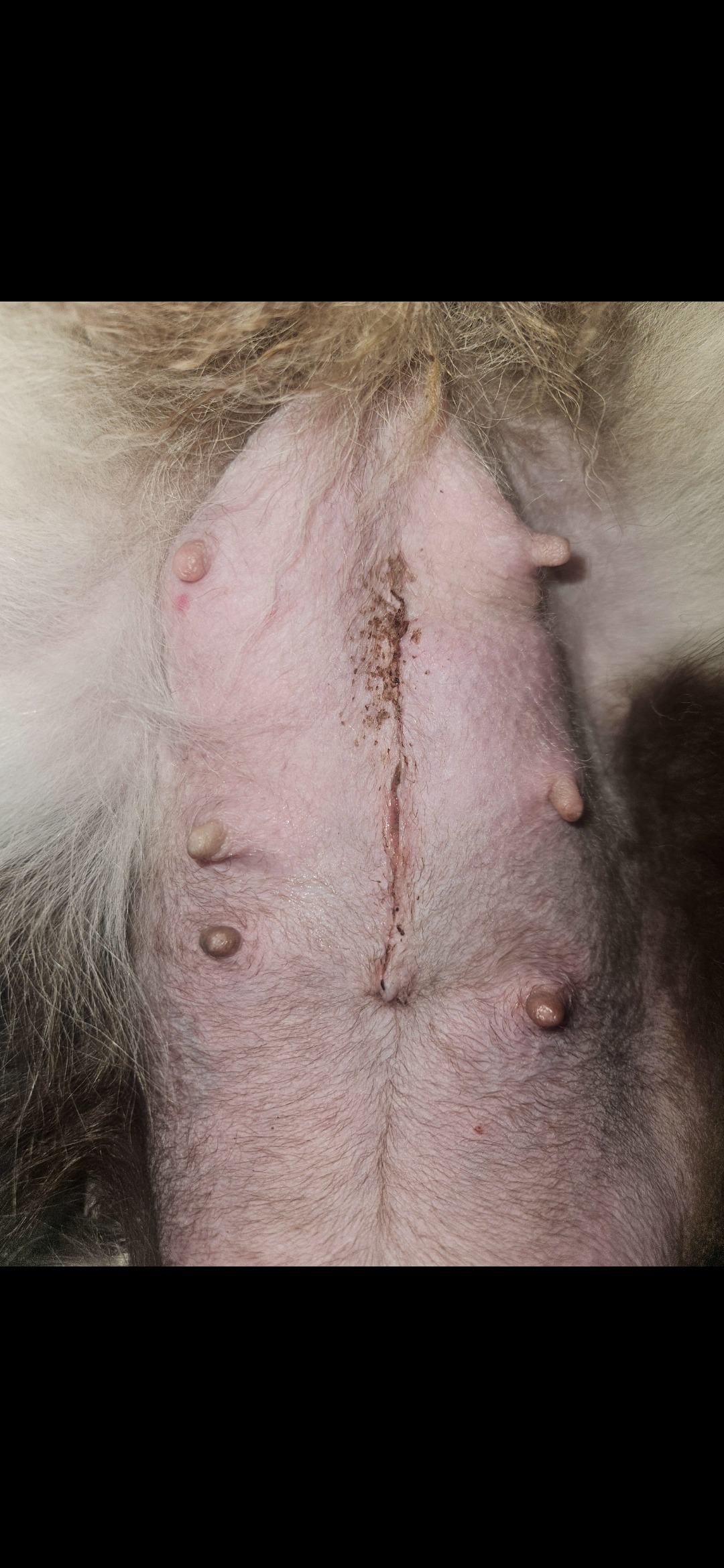
My dog got a c section about 5 days ago with glue stitches. Is she healing well or do I need to take her to the vet?

1 Response

Comments

  1. Krista Magnifico

    Hello,
    It is not appropriate to add a comment or assessment on a patient you don’t know via a photo. Please follow up as the surgeon who did your surgery recommended.

Question
Profile Image
Kate | 2 months ago
Hi. My Dog Had Surgery For A Sialocele (2 Surgeries Because The First One Failed). The Area …

Hi. My dog had surgery for a sialocele (2 surgeries because the first one failed). The area enlarged significantly after the second surgery and they drained the site. A cytology was done on a sample of the drained fluid and they said it was a seroma. They advised warm compress and said it would go away on its own. It has been about a month and the seroma has hardened and is now about the size of a tennis ball. It is my understanding that a seroma will not go away on its own once hardened. What would you do for this? The angst and cost of all this has been incredibly frustrating.

2 Responses

Comments

  1. Krista Magnifico

    Hello,
    When my dog had a seroma from a large mass that I removed it took months for it to resolve. So I know from personal experience that these can be frustrating.
    My best advice is to keep taking to your vet about your concerns and watch your pup closely. It’s often hard to know the difference between infection and seroma. But we don’t want to overlook the infection. Good luck!

    1. Kate Post author

      Thanks. Was your dog’s seroma soft the entire time or did it harden and shrink after hardening?

Regular Vet Visit
Profile Image
Lucy | 2 months ago
10 Year Old Dog Has An Exam
Treatment Cost (USD): $217.76
0 Responses