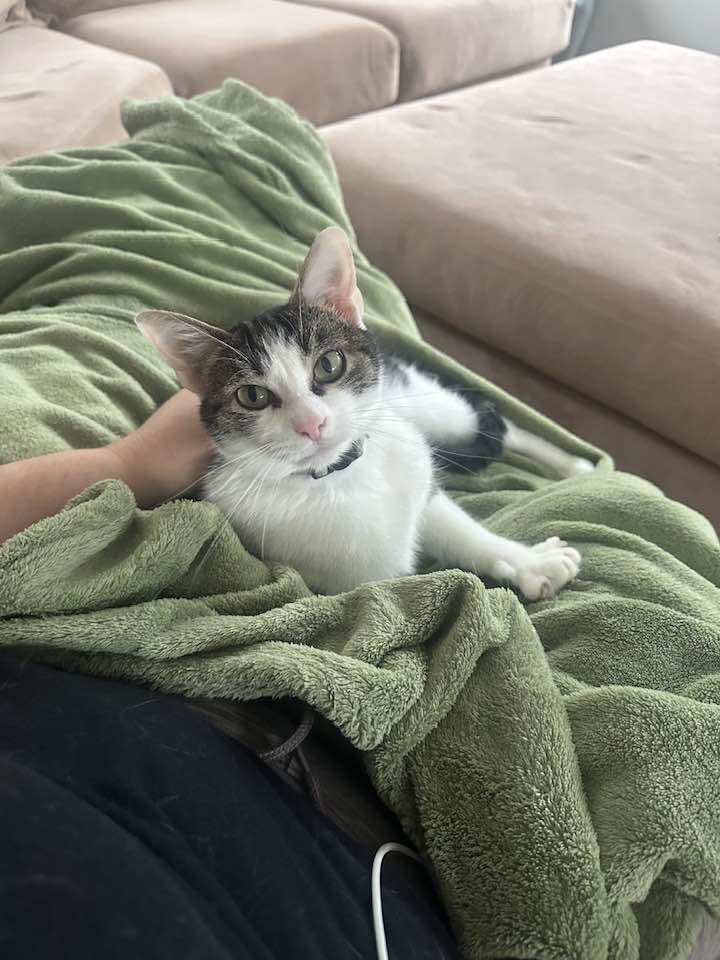
Sorry to hear about your sleep! Is she crate trained? Instead of playing with her all day and leaving her all night, try giving her short time outs. Step out of view for a few seconds. Come back. Step out of view for a few minutes and come back. Increase the amount of time you’re away from her so she learns that you’re coming back. Don’t make exits and entrances a big deal. Now is the perfect time to get your puppy into a training program where they can learn to socialize and a trainer can work with you on her anxiety as well. If you’re in the area we can recommend a few.

I have an intact 4 yr old Great Dane weighing about 160
Has had diarrhea (literally water) for the last 3 days no blood no mucus just water poop
Still eating and drinking normally
Doesn’t eat anything he’s not a chewer
I have other dogs who also was having the same issue however their cleared up
I’m not sure if it’s a virus that can spread between them
Where they picked it up
I am going to try to give him boiled chicken and rice this evening is there anything else to try
Comments
Hello, I am looking for advice on Separation anxiety for my 9 week old puppy. Made her crate small, pads for night, heartbeat cuddle down, music to calm her. She screams all night long. I play with her all day and wait til 11 to put her down so I can get some rest. I haven’t sleep in 8 days. Please help
Comments
Hello Dr. Magnifico,
My 2-year-old indoor male cat has had what appears to be three urinary blockage episodes within the last three weeks, and I’m looking for advice because we are running out of options financially.
About three weeks ago, he suddenly couldn’t urinate. I took him to our veterinarian. They expressed his bladder, and he passed what they described as a plug. They said he should be okay after that. Bloodwork was done, they found bacteria and gave him an antibiotic injection. They also performed a urinalysis and found crystals in his urine. However, we were not told to change his diet or given any specific recommendations.
He has always eaten dry food because he has never liked wet food. This is my first pet as an adult, so I didn’t realize how important diet could be for this condition.
About two weeks later, he became unable to urinate again and he also vomited twice. We got him back to the veterinarian. They took X-rays and said there were no bladder stones, but that he had another urinary blockage. They recommended hospitalization, anesthesia, catheter placement, and flushing his urinary tract. He stayed at the clinic for two nights.
Before discharging him, they told us there was no longer any blood in his urine, removed the catheter, and said he was okay to go home.
He has now been home for about 30 hours, and as far as we can tell, he still has not urinated. After watching several educational videos, I tried to gently feel for his bladder. It does not seem very large or hard, but the fact that he hasn’t urinated for over a day makes me think something is still seriously wrong.
Yesterday after coming home he was relatively active and walking around. Today he has mostly been sleeping all day. He has not vomited today, but he is eating very little, drinking very little, and for the last several hours he has barely moved.
Over the last three weeks we have already spent about $4,000 on his treatment, and unfortunately we simply cannot afford another expensive hospitalization.
I understand that this may be an emergency, and if he is truly blocked again, he may need immediate veterinary care. However, before making another decision that we may not be able to afford, I would be very grateful for your opinion on whether there is anything else we should consider or whether there are any reasonable alternatives.
P.S. I have watched several videos on your YouTube channel, and I truly appreciate the time and effort you put into helping pet owners. Your videos have already helped me better understand what my cat is going through, and I’m very grateful for everything you do. Thank you.
Comments
Good Morning Dr. Magnifico,
On June 15 and 16, I watched videos of you identifying and removing a polyp from a black and white cat “Pip”. The list of Pip’s symptoms match up perfectly with my cat and I thought – WOW – here is the vet with the answers I have been looking for! I am located in Thurmont, MD.
Since taking on my stray cat nearly 2 YEARS ago, she has seen 3 different vets and her symptoms have never resolved:
Persistent, loud snoring and snorting
Non-responsive to different antibiotic treatments (also non-responsive to steroids and antihistamines)
Chronically snotty – persistent nasal discharge
Chronic increased respiratory effort / visual abdominal breathing
Chronic sneezing (as well as intermittent fits of sneezing)
Intermittent eye discharge from inner corners
Head shaking / ear rubbing
In December of 2024, I rescued Sally who was posted on Facebook as “stray cat – very sick and needs help”. I have been interested and active with TNR, colony caretaking and fostering, as my time and budget allows, for the last 5 years. My intent was to get her the vet care she needed, foster her temporarily, and get her on the waitlists at the local rescues so she could eventually make it to an adoption center to find her forever indoor home. Sally was underweight and displaying upper respiratory “cold” symptoms. Runny nose, trouble breathing, sneezing. I assumed URI.
Sally had 3 visits at a local vet clinic (Thurmont, MD) in December 2024, January 2025 and March 2025 (two different vets saw her here). She was estimated to be between 10 and 15 years old. Per the vet, “her canines have dropped but her eyes look great.” She tested FIV/FELV/HW negative on two separate occasions. We tried several different antibiotics to treat her. We sent out a PCR culture, which returned positive results only for Calicivirus. We also ran a test on her kidneys which had normal results. I had a follow-up discussion with the vet the week of March 31, 2025 because her noisy breathing had not resolved after 4 months of being in a controlled environment. He said that because we’d tried several different antibiotics at that point, and at that time the vet said he did not see any visible polyps in her mouth or ears, his next recommendation was to refer me to a specialty clinic. I said that I wasn’t able to commit such significant additional funds to diagnostics at a specialty clinic, so as a last-ditch effort he prescribed a steroid to see if that would help clear up her breathing. It did not.
I often take my friendlies / kittens to a low-cost clinic in Frederick, MD for vaccines and snap testing before they go to adoption centers. Earlier this year, I discussed Sally with the vet that runs the clinic and he assured me he likes “puzzles” and would be happy to do an exam on Sally at his regular practice in Frederick, MD to see if he could find the cause of Sally’s symptoms. On April 11, 2026 I took Sally to see this vet and he almost immediately noticed an infected tooth. He advised that she needed the tooth removed and other diagnostics wouldn’t be accurate until the tooth was resolved. On April 17, 2026 Sally had the tooth removed under anesthesia. Unfortunately, her chronic rhinitis and all other symptoms have remained unchanged. This vet has now recommended taking her to a specialty clinic.
Sally has lived in my garage with 1 other cat for over a year and a half. The other cat has never developed any illness or health issues – which adds to the theory that Sally’s symptoms are not due to a virus. I’ve also had dozens of other foster cats in and out of the garage over the past 2 years and again, none have developed illnesses that would indicate she has a contagious virus. I feel that the positive Calicivirus results (and also the infected tooth) have muddied the waters on the path to finding answers.
Adoption centers won’t take her until her symptoms are resolved. I cannot afford to take Sally to a specialty clinic. Project Hope was able to assist with a little bit of financial support on her most recent vet bills, but I’ve spent over several thousand dollars in vet work on her and I simply can’t afford to continue. I feel terrible that Sally isn’t getting the love and attention that she really deserves in her golden years. She does have the other cat with her in my garage space, but she deserves a family.
I am grateful for any guidance and expertise you can share. I would love to bring Sally to see you.
Comments
Why is Oliver making this sound, and what can be done to help him?
Oliver is a 13 year old domestic short haired cat. We rescued him as a stray when he was around 5 weeks old and he had a respiratory infection, which we cleared up. Oliver never meowed like normal cat. It is a low soft hoarse meow – like a whisper. It has been this way his entirely but he has been an otherwise healthy, playful cat even through today. Starting around 8 years ago, he developed IBD, and was on numerous dosages of steroids to combat this over the past 7-8 years, always at the direction of our Veterinarian. The steroid treatment stopped about 1 year ago, when we found Science Diet Biome eliminated his IBD symptoms.
For the past two-three years, Oliver made a snoring sound while sleeping, but never while he was awake until December 2025, when he started making a loud snoring sound and wheezing/whining sound. We took him to the vet who said it was likely an ear infection, and he was given prescription ear drops. He continued showing symptoms, and in February 2026 the veterinarian prescribed another antibiotic (Clavamox) because he had dry mucus clogging up his left nostril.
On March 11, 2026 Oliver discharged a LOT of bright red blood from his left nostril. He was lethargic.
On March 12, we took him to the veterinarian who examined him and said that it’s possible that there is a mass. Her recommendation was to go to an animal hospital for further evaluation, but she also prescribed an antibiotic (Clavamox). We took Oliver the same day to Red Bank Animal Hospital and they said it was likely respiratory and prescribed a different antibiotic as a first treatment and a steroid, and to follow up after if no improvements for a CT Scan to confirm if there is a mass. Since this visit, he’s been on a daily transthermal steroid to slow the growth of a possible mass.
At this point in time, no vet has examined behind his soft palate to see if there is a polyp. We asked all the vets that have seen him if they can look in his nose or throat with a camera or scope, but they they don’t have instruments small enough, and only push a CT Scan which is an astronomical sum of money.
On March 28, 2026 I took him to a different vet for another opinion and basically was given the same recommendations for treatment.
Around May 4th, 2026 , for a period of 3 solid weeks he stopped making the snoring noise entirely, but then it returned.
On July 9, 2026, Oliver relapsed with a stuffy right nostril with green-yellow thick mucus).
On July 10th he had blood mixed in with the thick mucus. (see photo attached)
On July 11th the vet prescribed 25mg Zeniquin for 14 days. This has cleared the mucus, but the snoring sound continues to this day.
Throughout this entire period, he has not lost any weight, continues to eat normally, and shows no other symptoms. He is still on the transthermal steroid which receives daily because he does not take pills easily.
We live in central NJ, and I found you on Facebook and see the wonderful things you are doing and I spoke to your office who instructed me detail his symptoms here in advance of our visit to your office. I look forward to your reply and hope that you can help Oliver as we cannot afford a CT Scan and do not know what else we can do here.
thank you,
Katie
Comments
Hello,
We brought in a stray kitten almost 4 years ago who showed up in your yard.
Unfortunately, he is easily stressed by our active household with other cats, dogs, and kids. As a result he has increasingly frequent stress-induced urinary tract infections and blockages.
Our vet diagnosed him with Feline Idiopathic Cystitis. We have tried every remedy we can think of to heal him. He is on fluoxetine for anxiety, gabapentin, steroids, and cerenia for painful flares or stress. He is on an all wet food diet, has a water fountain and four litter boxes that are always clean for him to use with both pellet and traditional litter.
Despite all of this, he is constantly peeing on our clothing, our bedding, and our furniture. It is incredibly stressful, unsanitary, and a huge financial burden to our family. We love our cat and don’t want to lose him because despite all of this he is very sweet and affectionate.
We are at the point where we are considering the PU surgery, even though we don’t have the financial means to do so. I am fearful that it won’t fix our problem and even after this huge investment, he will still have flares. Is my only other option to rehome him to another household with no other pets or children that might cause him stress?
Thank You.
Comments
Five Year Old Cat & (Subcutaneous Ureteral Bypass) 3.0
My little one eyed wonder of a cat that I have loved since adopting for a little over five years now had to go through ureteral bypass surgery. My cat does not have kcd as she is young and still very healthy, but based upon imaging / ultra sound scans I went through to get to an answer, doctors deemed there was a blockage of my cats right ureter / Kidney. It seems highly this is a kidney stone, but the doctor said the bypass / sub 3.0 was the best route for longevity lifespan. I agreed to this as I don’t think there is alternative methods to resolve a blocked ureter without any critical harm to the ureter itself (I had hoped prior to agreeing that there was shockwave lithotripsy or ureteroscopy as there is solutions to humans with kidney stones, but I guess the technology is not present to help pets with stones & or the animal anatomy as the organs are extremely tiny.) The doctor executed the surgery successfully and my cat is currently in the healing process wearing onesies & soft cones to prevent scratching / licking of the stiches / surgical area & in a recovery tent at home.
I have had all of this done so far at CVSS & by their staff, which again have been amazing. This blockage was caught early at my primary vet care with routine yearly bloodwork & reviewing the kidney functional numbers. My primary vet recommended CVSS for this issue after the imaging as they could not execute this level of required medical help. As said, I consulted the doctor / surgical specialist & the sub 3.0 surgery was executed successfully. Numbers after surgery seem to be returning to normal based on my cat’s age. I also now face seeing for the rest of my cat’s life an internal medicine specialist to execute sub flushing’s of the device to prevent blockages / calcification buildups. I also now give my cat prescription diet food (hills renal) to help prevent these buildups in the future.
Knowing all of this & how far I have gone so far, I accept this sacrifice to my pet. This pet is my family & life. I am happy with everything so far that has happened with my pet and the outcome. No bad ill feeling towards my primary vet & CVSS. In all of this I guess my question is am I being duped cost wise by the system? The surgery was an extremely expense cost financially, but I accepted it as I just wanted to save my pets life. Should I have sought out another site to execute the surgery? Should I seek out another site to execute these lifelong flushes of the sub 3.0 device as I do not know as of yet what that cost will be & the cost of the future flushing’s. Maybe because of the state I live in this is costly & or due to economic state.
Again, I simply accept I just wanted to save my cats life. I love my cat & would travel to the ends of the earth to save my cat. This blockage was caught early and hopefully is now resolved. It seems to be. I am simply just asking about the future & if I should be seeking elsewhere to execute these lifelong flushes of the sub 3.0 device & review of my pet. Sorry for the essay question essentially, just wanted to put out my story and hopefully just be given insight / experience into the future.
Comments
I brought my 16 year old female cat to see a vet on Friday due to vomiting, constipation and lack of appetite and she had an x-ray and bloodwork done. The x-ray came back w/ foreign matter but wasn’t sure if it was solid or would pass on it’s own and was advised to go to ER for ultrasound. I brought her to ER for ultrasound and they advised the foreign matter should pass on its own and she may have a minor UTI and was sent home w/ Clavacillin antibiotic.
She didn’t improve over the weekend and had stopped eating so I brought her back to her regular vet on Monday. Vet said she didn’t have a UTI, just crystals in bladder since urine is concentrated so I stopped Clavacilln after 1 day. She said blood work looks good and did another x-ray and foreign matter appeared to have been digested and piloris no longer distended. Went home with Cerenia and Mirtazapine for appetite. This hasn’t helped with her appetite. She hasn’t eaten on her own for 6 days and last bowel movement was 7 days ago (she had a very small like 1/2 to 1 inch inch one a couple days ago)
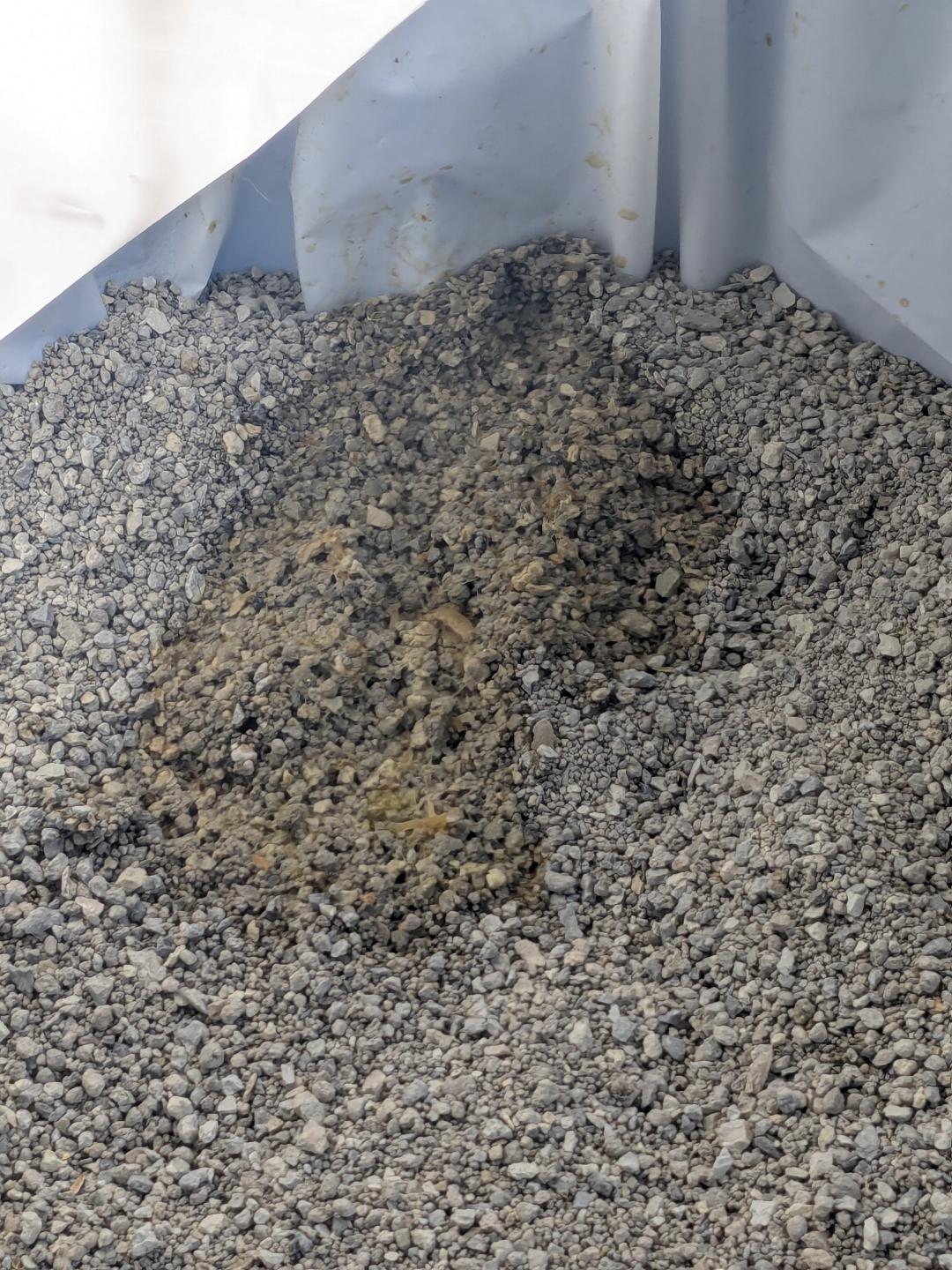
I’ve been force feeding her and watering with a syringe. I feel so bad about this since she doesn’t want it. She’s used to a raw diet and I abruptly changed to Tiki Velvet Whip Mousse packs since I can easily put in syringe. I was thinking about pureeing her raw food to feed her, though not sure if this is a good idea since she is not having bowel movements and it’s raw. She just had what looks like vomit in her litter box but I’m pretty sure its a mucous she excreted anally due to the sudden change in food (attached photo). She hasn’t vomited in a week which is good I think.
Her vet suggested an enema a few days ago but when I brought it up today she said she doesn’t seem constipated since she felt her stool with her fingers and it was hard and not too large to pass so she should be passing it. I would still like her to have the enema, what do you think? I was hoping her lack of appetite and nausea was due to constipation and the enema would help, though I don’t know. Also, I am picking up Predisolone for her tonight prescribed by vet to help with appetite. Any opinions, ideas, suggestions would be greatly appreciated. Thank you so much.
Comments
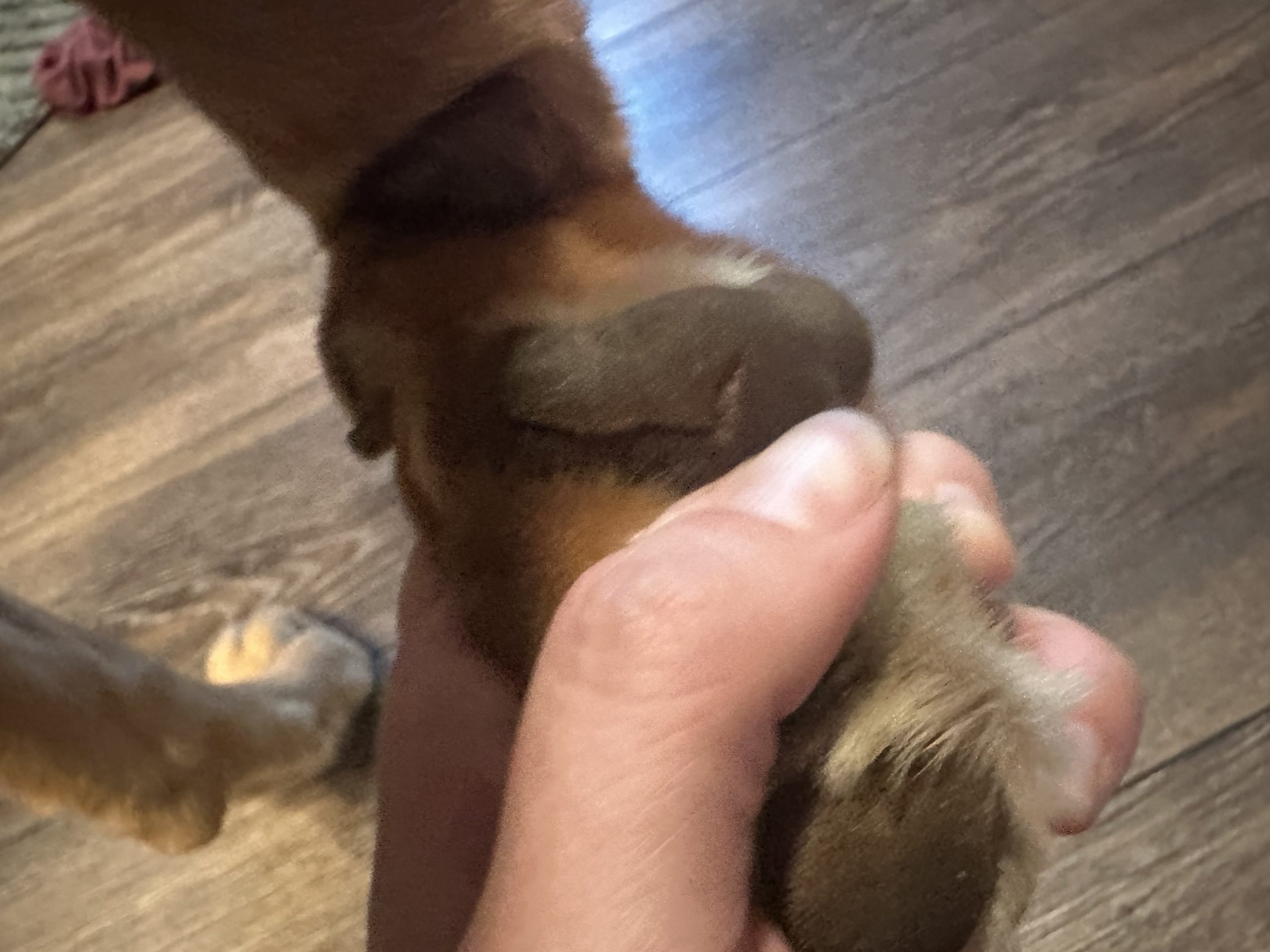
My lab cut the pad on her paw tonight. It is a pretty decent cut but never bled. It is now a flap of her paw pad that if you gently lift you can see the flesh underneath. I cleaned it with warm water and let it dry and now have it wrapped with gauze and self adhesive wrap with a sock over it to stop her from licking it. My question is should I take her to the emergency vet or can it wait to be evaluated until my vet is open for walking on Sunday?
Comments
Hello ❤️ our cat Spicy Chicken, has been biting at her heal for about a week and a half. She is indoor only and completely scared of strangers (or we would be at the vet) is there anything I can do for the back of her foot? Still very active, no limping, eating/drinking fine. Just bites at her heal sometimes. Thank you


Hello,
There are numerous reasons pets get diarrhea. If they are on a broad spectrum heartworm prevention then I worry less about parasites, which leaves stress, and diseases more likely. Overall a short transient case of diarrhea doesn’t get me too worried but days long episodes are what addressed by a vet visit. Make sure to bring a fresh fecal sample.